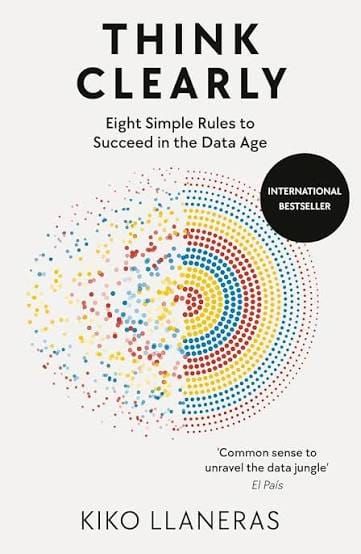
By Kiko Llaneras (2022) Pages: 288, Final verdict: Good-read
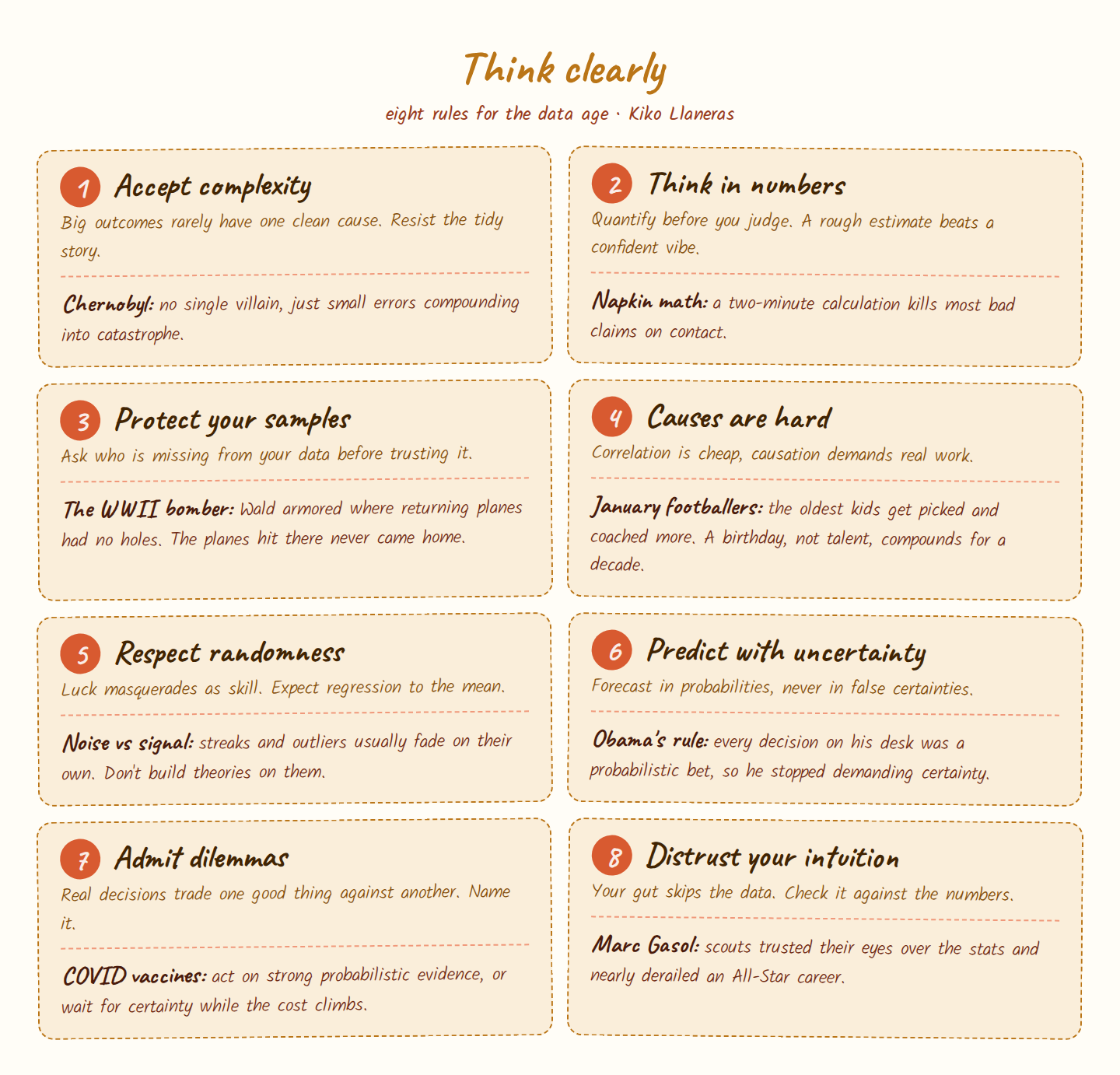
You’ve probably seen the WWII bomber with the red dots. Engineers mapped where returning planes had been hit and wanted to armor those spots, until statistician Abraham Wald pointed out they were looking at the wrong planes: the ones hit elsewhere never made it home. The story is a perfect little lesson in survivorship bias. It’s also, by now, a Twitter meme so worn out that people post the plane as a reply whenever someone draws conclusions from a biased sample.
Kiko Llaneras, a data journalist at El País and PhD in industrial engineering, wrote a book about many such stories. One that made him a household name in Spanish nonfiction: Piensa claro (Think Clearly) went through five editions, was translated into English and Korean, and earned blurbs from John Burn-Murdoch of the Financial Times and Max Roser of Our World in Data. It’s definitely a fun read. Whether it’s a valuable one depends almost entirely on who you are.
“It’s a list, as you might expect. A compilation of dozens of useful pieces of advice, a kind of pattern to help you think better. Some are masterful shortcuts and others are warnings to avoid traps. They function as a checklist. They remind you of the type of questions that are good to ask when analyzing any issue, big or small. - Kiko Llanrenas, Thinking Clearly
A bootleg Malcolm Gladwell (I mean that as a compliment)
It's a familiar formula: a counterintuitive story, rooted in data, with an ending you didn’t see coming. Why do so many professional footballers have birthdays in January? Because kids born early in the year are the oldest in their age group, get picked more, get coached more, and the advantage compounds for a decade. What did Barack Obama figure out about decision-making that let him sleep at night? That by the time a decision reached his desk it was always a probabilistic bet, never a certainty, so he stopped demanding certainty. Why did a ridiculous prejudice nearly derail Marc Gasol’s career? Because scouts trusted their eyes over the numbers.
If this sounds like Malcolm Gladwell, it is, with one lengthy difference: Llaneras skips the storytelling. Where Gladwell would spend 30 pages on the Gasol anecdote, complete with a scene in a Memphis gym and a digression about his childhood in Barcelona and uber-famous older brother, Llaneras gives you the story in two pages and moves on. Each of the eight rules to “Think Clearly” contains a dozen short patterns: some are practical shortcuts (do napkin math), others are warnings (don’t confuse noise and signal). The book reads like a well-edited newsletter archive, which, given that Llaneras runs one of Spain’s most successful paid newsletters, is probably not an accident.
The engineer shows through in the best way. There’s no filler, no manufactured suspense, no chapter that exists to pad the page count. You can read the whole thing in a couple of afternoons.
The eight rules are the right rules
The structure is eight commandments for thinking in the data age: accept the complexity of the world, think in numbers, protect your samples from bias, assume that attributing causes is hard, never underestimate randomness, predict without denying uncertainty, admit dilemmas, and distrust your intuition.
This is a solid curriculum. Correlation versus causation, survivorship bias, the relative age effect, regression to the mean, base rates, superforecasters and probabilistic prediction, why we knew COVID vaccines would work before the trials finished. Llaneras covers the canon of statistical literacy with clear examples and zero condescension. The Chernobyl chapter, tracing how a sequence of small errors compounds into catastrophe, was my favorite in the book precisely because it’s the least familiar.
Hand this book to someone who has never read Kahneman, Gladwell, Dan Ariely, or spends little time on tech Twitter, and they will come out measurably better at reading the news, evaluating claims, and making decisions.
Bottom line
Some books get better as you get older; you reread them at 35 and find things you missed at 20. Think Clearly is the opposite. It's the perfect book for a college student. To someone curious, unexposed to those ideas, about to have their mind bent by survivorship bias for the first time.
This is not a bad book, by any means. It is a book with a shelf life that depends on your own. Llaneras is synthesizing, not discovering, and I don’t think he ever pretends otherwise.
It's a fast, well-built compression of the statistical thinking canon. You can read it in two afternoons, enjoy it, and forget most of it because you already knew it.
Or better: Gift it. This is the ideal book for a niece starting university, a smart teenager who inhales YouTube explainers, or anyone in your life who makes decisions on vibes and has never heard of a base rate. For them, it might genuinely change how they think. For you, it might just be a pleasant rerun.