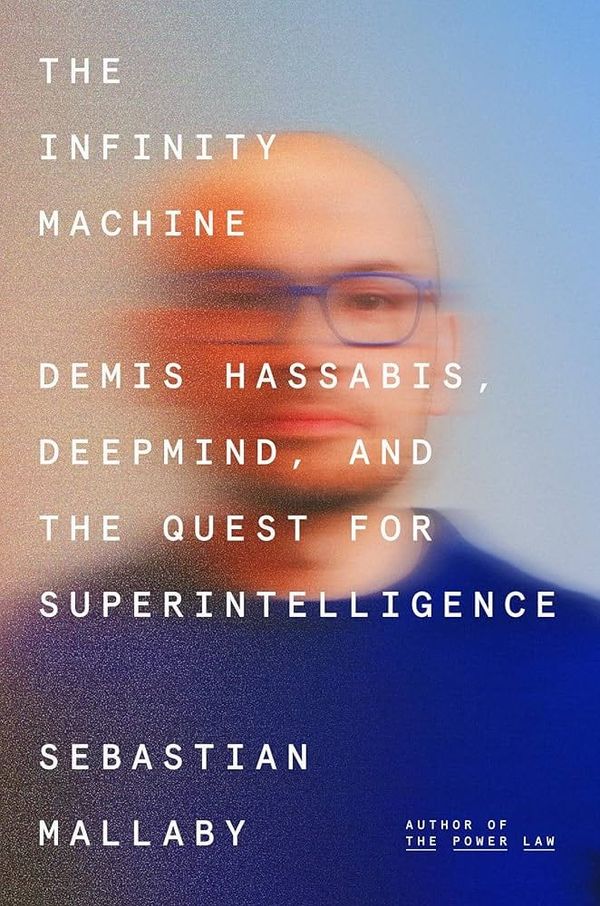
By Sebastian Mallaby (2026)
Pages: 480, Final verdict: Must-read
Chess prodigies are common enough that we have a template for them: the brilliant, socially awkward child who masters the board and then struggles to find a second act. Demis Hassabis didn't follow any of that template. He learned chess at four, funded his first computer with tournament winnings by seven, and wrote commercially successful video games before turning eighteen. Then, after a fateful match in Liechtenstein, he decided chess was too small and moved on.
The Infinity Machine is Sebastian Mallaby’s attempt to explain what happens when you take that kind of mind and point it at the hardest problem in science.
Mallaby, best known for his 2016 biography of Alan Greenspan, spent more than 30 hours in conversation with Hassabis and hundreds of hours interviewing the scientists and executives around him. The result is the most complete account yet of DeepMind’s rise and Hassabis’s story.
The man after a mission
DeepMind was founded in London in 2010 with a mission statement that read like science fiction: achieve artificial general intelligence by 2030. Or, as Demis liked to put it: first solve intelligence, then use it to solve everything else.
At the time, there was little VC money funding AI, and the ones that were were in Silicon Valley, not in the UK. The idea that a small London startup with a neuroscience-inflected approach to intelligence could compete, let alone lead, struck most of the industry as eccentric.
The first proof came in 2013, when DeepMind trained a neural network to play Atari games from scratch, with only pixel inputs and no programmed rules. Google bought the company for $650 million in 2014, before the results were even published in Nature. Hassabis extracted something unusual from that deal: a promise that DeepMind's technology would never be used for weapons or surveillance, and a commitment to an internal ethics board to oversee AI work across all of Google. At a time when AI safety was barely a formal field, he was already trying to build institutional protection against what his own work might eventually produce.
What Demis's character is defined by, above all else, is the mission. When a colleague urged him to publish AlphaGo results that would earn the title of world's best Go program, he vetoed it. The goal was to beat the best human alive, not to beat other machines in a footnote. AlphaGo (2016) did exactly that, beating Lee Sedol in a match watched by over 200 million people. AlphaZero (2017) went further: it learned Go, chess, and shogi from scratch with zero human data, and crushed the best human-crafted chess engine on earth, finding moves that shocked grandmasters who had studied the game for centuries.
Then, the same instinct shaped AlphaFold. When a researcher pushed to declare victory at the protein folding competition CASP and move on, Hassabis refused. The point was not to win CASP; it was to solve the protein-folding problem. In 2020, AlphaFold 2 predicted the 3D structures of nearly all known proteins, solving a problem that biologists had called a "grand challenge" for 50 years. Hassabis won the 2024 Nobel Prize in Chemistry for it. "I wouldn't have swapped this for any amount of money," he told Mallaby.
Code Red
In 2017, a team of Google researchers published "Attention Is All You Need", the paper that introduced the transformer architecture. Ilya Sutskever at OpenAI read it and immediately grasped what it meant. DeepMind, the most celebrated AI lab in the world, didn’t. Hassabis had spent his entire career refusing to follow anyone. That instinct had worked brilliantly in reinforcement learning and protein folding. Demis, David Silver, and many others at the company believed that language alone was not enough to produce an intelligent system. That turned out not to be (mostly) wrong.
For too long, DeepMind had held its research line, while Sam Altman and OpenAI built the most consequential consumer product in the history of AI in five years. Google was furious. It was Code Red in Mountain View. But the merger gave Hassabis the resources, mandate, and organizational position to finally close the gap, and he moved fast:
- 2017: Google researchers publish "Attention Is All You Need". The transformer is born inside Google.
- 2019: OpenAI raises $1 billion from Microsoft and bets the company on large language models.
- 2022: OpenAI ships ChatGPT. 100 million users in two months.
- 2023: Google releases Bard. In the launch ad, the model is asked what new discoveries from the James Webb Space Telescope a parent could share with a nine-year-old. Bard claims the telescope took the first pictures of planets outside our solar system. It hadn't (the European Southern Observatory did). The error goes viral, and Alphabet loses $100 billion in market value in a single day.
- 2023: Google merges Google Brain and DeepMind into Google DeepMind. Hassabis takes the helm of the combined unit, effectively becoming the de facto number two on AI at Google.
- 2023: Gemini 1.0 launches. Google DeepMind is back in the race.
- 2024–2025: The comeback accelerates. Gemini becomes a serious contender to GPT-4. Google ships AI Overviews into Search, defying its own innovator's dilemma. Nano Banana becomes the best image generation model in the world, alongside Veo 3 for video generation.
On top of this roller coaster, the governance story Mallaby tells is a different kind of messy. When Hassabis and co-founder Mustafa Suleyman sold DeepMind to Google, they pushed for unusual protections: a weapons ban and an internal ethics board. Great ideas, in theory. Suleyman, the co-founder most responsible for the safety agenda, eventually left Google under murky circumstances, and the need to accelerate product development took everyone's mindspace away from AI Safety.
Mallaby (and many in the industry) draws the Oppenheimer parallel explicitly, and all it takes is looking at the game of musical chairs among AI safety folks to understand how nobody has safety fully figured out. Knowing the risk and having the political skill to do something about it are two very different things.
Bottom line
I'm usually skeptical of biographies of people still in their prime. There's an inherent problem: the story isn't finished, the subject is still making decisions, and the author is working without the benefit of hindsight.
But in The Infinity Machine, that’s ok. Mallaby balances Demis's personal history with the broader arc of AI development without feeling forced. The second half of the book, covering the ChatGPT moment and Google's scramble to respond, will probably not age perfectly.
But reading it in 2026, I found it inspiring and motivating, a story of someone with a focused mission, a genius mind, and the tenacity to see it through.
The main caveat is that Mallaby is clearly sympathetic toward his subject. Hassabis rarely gets a hard challenge in these pages, and the book is also unusual in how little it reveals about his personal life.
As a European, I'll add something the book reinforced for me: there's something worth celebrating in the fact that what might be the most consequential technology ever built is being developed in London, not (only in) San Francisco. DeepMind is proof that you don't always need to be in the Valley to be at the frontier.
The Infinity Machine is my favorite read of 2026 so far.
Further learning
- Buy the book
- AlphaGo documentary — the 2017 film about the match against Lee Sedol. Watch it before or after; either works.
- The Thinkin Game — a short documentary on Demis Hassabis and the origins of DeepMind.