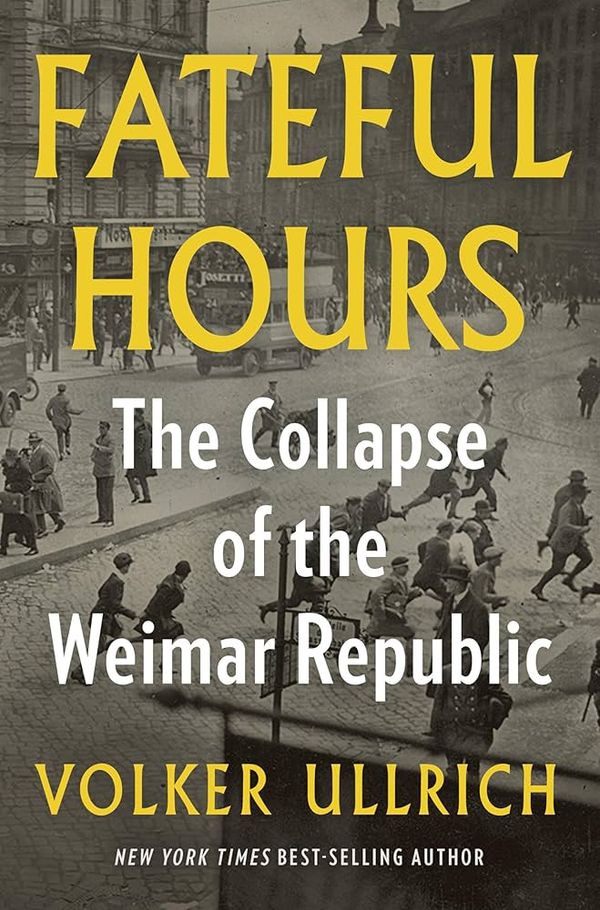
By Volker Ullrich (2025) Pages: 384, Final verdict: Great-read
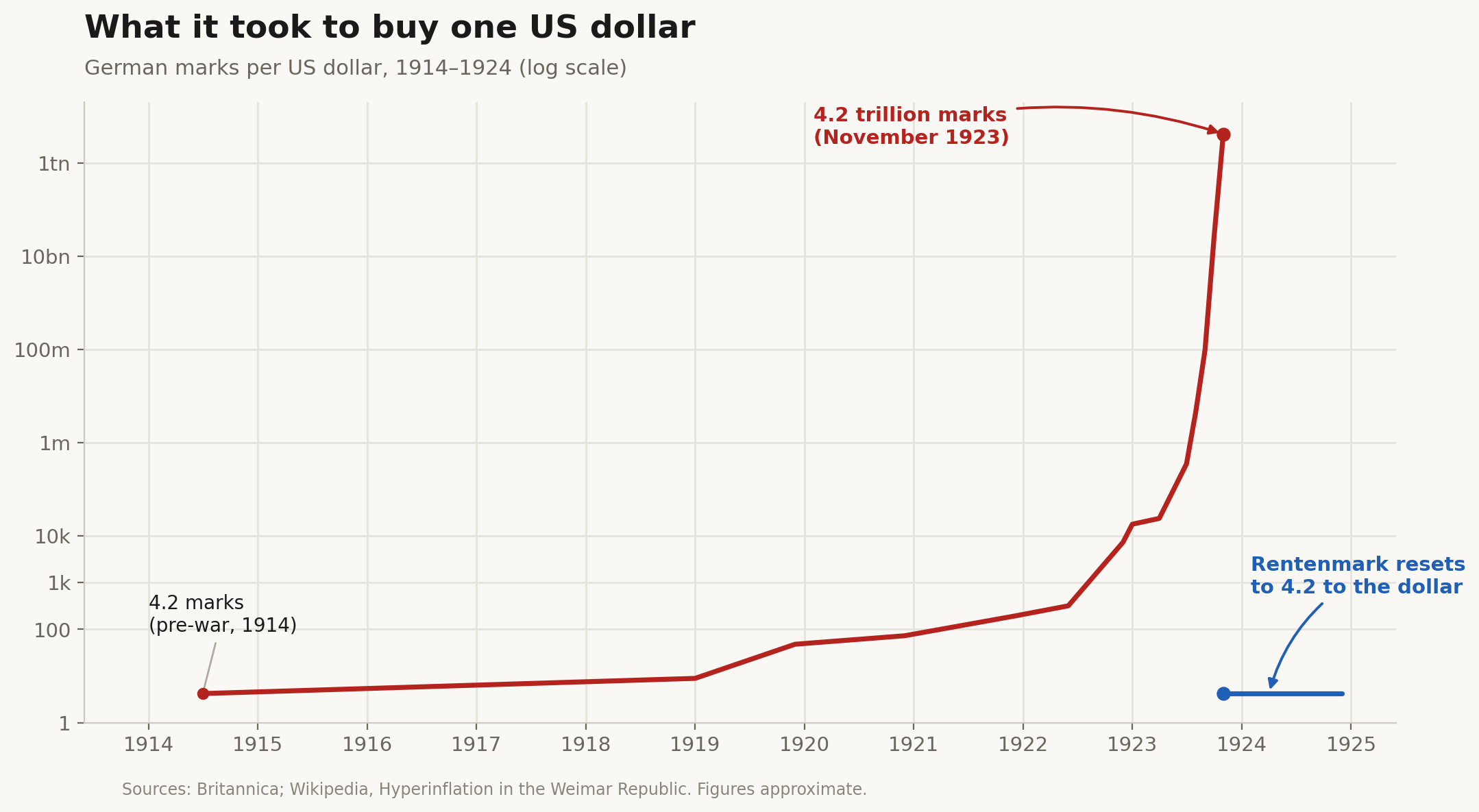
The image most of us carry of the Weimar Republic is a wheelbarrow of banknotes. A loaf of bread that costs billions of marks. Savings erased between breakfast and dinner. It's a visual, and vivid image. But the wrong one.
Germany lived through that hyperinflation in 1923 and came out the other side. The republic that handed itself to Hitler ten years later had already survived its worst monetary nightmare, stabilized, and enjoyed half a decade of near-normality. Whatever killed Weimar arrived later, and from a different direction.
That gap between myth and mechanism is what makes Fateful Hours a great book. Volker Ullrich, best known for his two-volume Hitler biography, walks the republic's fourteen years step by step, from the 1918 November Revolution to the morning Hindenburg made Hitler chancellor. His thesis is stated plainly and defended clearly: none of it was inevitable.
A democracy that never stopped almost dying
Weimar was born under a bad sign and never recovered its balance. It inherited a lost war, the Treaty of Versailles, and a working assumption among much of the elite, from the Rhineland industrialists to the estate owners east of the Elbe, that the whole experiment was illegitimate. So it lurched from crisis to crisis. Cabinets formed and fell. Political murder became routine. Putsches came from the right and the left.
And that danger was as much structural as economic. As an anecdote, Ullrich notes that most German university students turned their backs on the republic early, scuffing their feet whenever the word "constitution" came up in a lecture (not so different from the groans in some commencement speeches today whenever AI gets mentioned). And the collapse, when it came, was gradual.
The myth of the wheelbarrow
The 1923 hyperinflation was real and savage. Crime rose in lockstep with the collapsing mark, an atmosphere one writer, Ullrich, cites as "everyday anarchism." It scarred the German middle class for a generation. But it didn't end the republic. Germany issued a new currency, the Rentenmark, late that same year and broke the spiral almost overnight. The 1924 Dawes Plan restructured reparations and opened the taps on foreign credit. What followed were the "golden years," roughly 1924 to 1929: stable money, working coalitions, a cultural boom. The republic took the worst economic punch imaginable and stayed on its feet.
What killed it was built on borrowed money, most of it American. US banks financed the recovery with short-term loans, which worked beautifully right up until they didn't. When the New York Stock Exchange collapsed in 1929, American banks called in their German loans to cover themselves at home, and the economy propped up on that credit cratered. Unemployment exploded. That gave the Nazis their second life. It's easy to forget how dead Hitler's movement had been: after the failed Beer Hall Putsch of 1923, he went to prison, and the party drifted to the fringe, taking 2.6 percent of the vote in 1928. Then the Depression hit, and in September 1930, the Nazis jumped to 18.3 percent, from 12 seats to 107. The American capital that lifted Weimar in the twenties pulled it down in the thirties, and Hitler walked through the door the crash kicked open.
THE flaw in the Weimar Constitution
If there's one design flaw that haunts the Weimar Constitution, it's Article 48, which let the president take "necessary measures" whenever public order was seriously disturbed. In practice, that meant suspending basic rights and ruling by decree. By 1930, almost three years before Hitler, Germany was already governed this way: Chancellor Brüning ruled by presidential decree, bypassing a Reichstag that could no longer form a majority. The presidential dictatorship was road-tested and normalized long before the Nazis touched it. So, contrary to popular myth, Hitler didn't invent that instrument. He inherited a tool already in routine use and accepted by German society.
And the men holding it thought they were in control. Hindenburg, von Papen, and the backroom conservatives who finally installed Hitler were convinced they had "constrained" him; that the office would make him reasonable. They were wrong in the most consequential way anyone has ever been wrong.
Bottom line
Fateful Hours is a very good, somber book. It's a great service, especially for non-German readers, to take episodes most of us know only in outline (the 1919 revolution, the Munich putsch, the intrigues between von Papen and Hindenburg) and render them in close, human detail.
Two caveats. If you're not a big fan of German history, the level of detail that makes the book authoritative can be tiring: the process of cabinets and Reichstag arithmetic blurs if you put it down for a week. I found it hard to remember the names of cabinet ministers and other personalities after a couple of days' reading break.
And the big counterfactual, bracing as it is, can't be proven. We can't actually know the economy would have recovered by 1934 if Hindenburg had left Brüning in place. Still, Ullrich earns his central claim. Hitler's triumph was not, in his phrase, an "occupational hazard" of German history. It was a series of choices.
Democracies rarely die with a bang. They get signed away, decree by decree, by the people most certain they can manage what comes next. You finish the book unsure whether that is a lesson about 1933 or about the next time. If you read a German history book every few months the way I do, put this one near the front of the queue.
Further Learning
- Buy the book
- Listen to Reichs & Republics, a great podcast about German History
- Listen to Katja Hoyer's episode on Conversations with Tyler covering Weimar, the GDR, and the German character