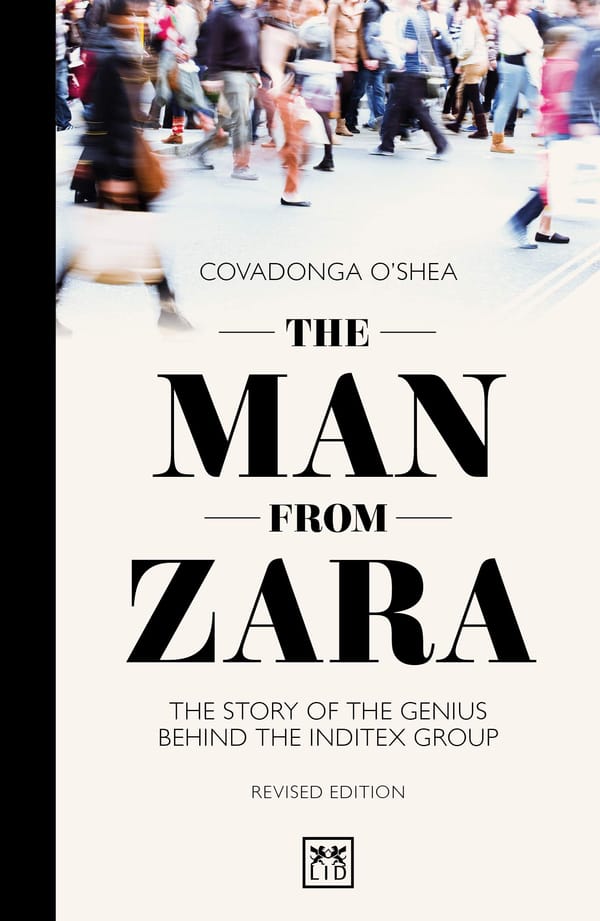
By Covadonga O'Shea (2011)
Pages: 272, Final verdict: Great-read
How does a fashion company manage to sense a trend, design a garment, manufacture it, and deliver it to stores around the world in a matter of weeks?
(Almost) only Zara knows. They did this long before “fast fashion” had a name, building one of the most efficient and influential retail systems of the last half century. The Man from Zara tells that story through the life of Amancio Ortega, the discreet founder of Inditex, as seen by Covadonga O’Shea, a Spanish journalist and president of the ISEM Fashion Business School, who gained rare access to Ortega and his inner circle over years of conversations and observation.
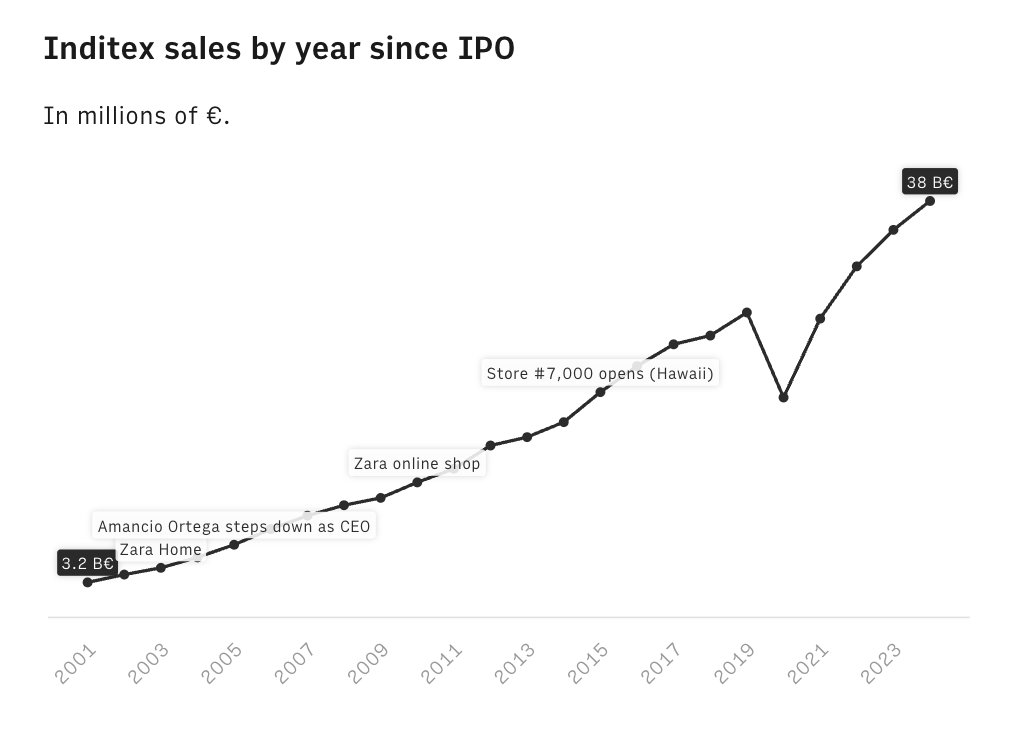
There is no doubt that Zara is extraordinary. With two thousand physical stores, more than $30B in revenue, and arguably the strongest fashion in the world, it's hard to underscore how important it is to the retail world. Long before “fast fashion” became a catchphrase, Inditex (the parent company who owns Zara) had already reengineered the entire apparel value chain. Zara can sense a trend, design a garment, manufacture it, and place it in stores in roughly twenty days. Around 40 percent of stock changes every week, and stores are replenished every few days rather than once per season. The company operates fast, with high gross margins (50-60%), and near total vertical integration.
Design, production, logistics, and retail speak to each other constantly. For a long time, this system allowed Inditex to grow to thousands of stores across dozens of countries while avoiding the crippling inventory risks that plague traditional fashion houses.
"Ortega’s dream which he shared with the group of managers with whom he worked, was to achieve nothing less than the best logistics system in the world; an unprecedented formula that would allow him to place a product in a store, regardless of its location, in under a fortnight. This was what he focused on with devotion. In other words, it would be a complete change in the world of retail and distribution." - from The Man from Zara
O’Shea explains these mechanics clearly, and some of the logistics details are genuinely fascinating. Garments are routed through automated distribution centers in Galicia, shipped on hangers or folded depending on their needs, and dispatched almost immediately to specific stores across Europe and beyond. Managers returning from any city are questioned closely about what sold, what did not, and why. Information flows upward and sideways with remarkable speed. The result is a company that behaves less like a fashion brand and more like a real time sensing organism.
Running through all of this, however, is Ortega himself. The book is deeply respectful of his character, his discipline, and his restraint. We are told again and again that he dislikes personal praise, insists on using “we” instead of “I,” and believes that nobody is bigger than the company. We learn about his childhood poverty, the moment when a shopkeeper refused his mother further credit, and how that experience pushed him into work at a young age. We hear stories of his humility, his personal charm, and the loyalty he inspires among employees at every level.
Much of this is compelling, and it is easy to believe it is true. The problem is one of proportion. Chapter after chapter returns to Ortega’s virtues, often in similar language and tone. Over time, the book begins to feel less like a business history book and more like a tribute. As a reader who wanted to understand the “man from Zara,” I found myself wanting more Zara and a little less man.
There are many moments when the book hints at what could have gone deeper. The early days of GOA Confecciones, the internal debates around logistics investments, the decision making behind acquisitions, or the internal dynamics of Inditex’s IPO would all have made for rich material. Instead, these events are often passed over quickly.
When I tried to walk into that first shop in the French capital, I couldn’t make my way through the solid barrier of people queuing in the street. I stood there in a doorway sobbing like a kid. I couldn’t hide it.” - Ortega on opening Zara's first store in Paris.
That is a missed opportunity. Zara is not impressive because one man was admirable, but because a system was built that could scale, learn, and adapt without relying on charisma. The irony is that Ortega himself seems to understand this better than the book that celebrates him. At one point, he insists that it was never just him who built the firm, but tens of thousands of people working together. The narrative rarely follows that insight to its natural conclusion.
In the end, The Man from Zara is still a worthwhile read. It offers a good, rare (outside of business school case studies) introduction to the logic behind Inditex’s success and a humane portrait of a founder who avoided the spotlight while reshaping global retail. But if you're hoping for a detailed operational history of Zara, or a more critical exploration of how such a system was built and governed, you'll come away disappointed. The man is fascinating. The company is even more so. I only wish the book had trusted the story of Zara enough to let it stand on its own.
Further learning
- Buy the book
- Listen to the Founder's podcast about the book and Ortega.