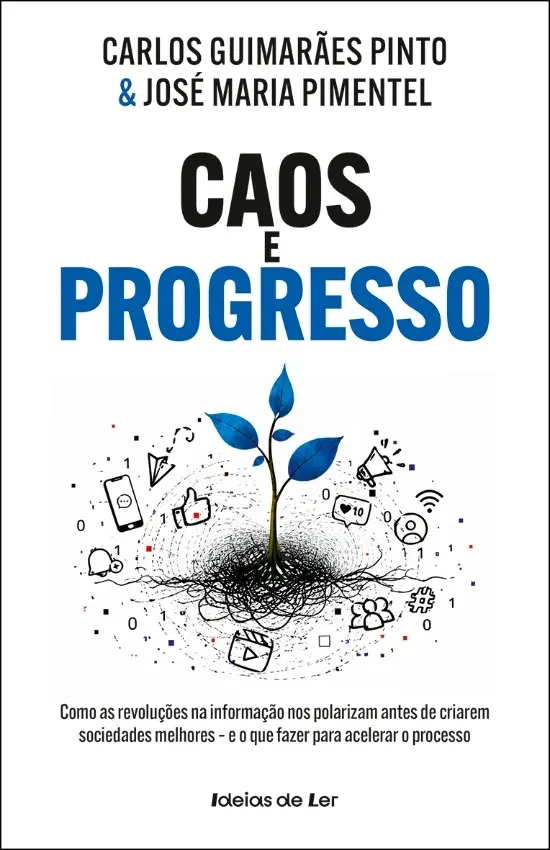
By Carlos Guimarães Pinto e José Maria Pimentel (2026)
Pages: 240, Final verdict: Great-read
In eleven years of writing book reviews, I have reviewed only two Portuguese books. Nuno Palma’s As Causas do Atraso Português was an exception because it changed how I understood my own country. Caos e Progresso arrived here for a different reason: I already knew, followed, and admired the people behind it.
José Maria Pimentel hosts 45 Graus, a podcast of long, curious, no-BS conversations with guests from different fields. It’s probably my favorite Portuguese podcast. Carlos Guimarães Pinto is one of the political voices I most appreciate in Portugal: logical, intellectually honest, and focused on the mechanisms that make countries more prosperous.
The subject couldn't be more timely. What happens when new, disruptive information technologies are introduced to society? How can we see the current digital revolution through the lens of the past and learn from its mistakes?
“It’s a book with history, not of history. Talks about technology, but it is not about technology. Talks about politics, but it is not about politics. It’s about the present and the future. It’s about human nature.” - Caos e Progresso
We have been here before
The central model is simple: deslumbramento, caos, progresso (fascination, chaos, progress). First comes fascination with a new technology. Then comes the chaos, as information (appears to) moves faster than the institutions and habits built to handle it. Progress becomes possible when society develops ways to keep more of the benefits and contain the damage.
It starts with Gutenberg’s printing press. Cheaper reproduction made ideas easier to preserve, distribute, and challenge. But the same machinery that made ideas easier to spread also circulated religious attacks. The Reformation, which began as a theological argument against the Catholic Church, became an information revolution in which pamphlets and translations helped ideas escape the institutions that had previously controlled their distribution.
Radio offers an even sharper contrast, and a prime example of technology’s duality: Goebbels used broadcasting as part of a system of propaganda and repression. Roosevelt used it to explain government policy directly to Americans through his fireside chats. The technology could carry either message. What mattered was who controlled it, what competing voices remained available, and what political system surrounded it.
“Every generation thinks it is living through historical moments never lived before. Dangers more dangerous than ever seen. Challenges more challenging than all previous challenges of humankind.” - Caos e Progresso
The end of the middleman
Social media makes that redistribution easy to see. A politician no longer needs a newspaper editor to consider their message newsworthy. A fringe group no longer needs enough supporters in one town to become a community. A provocative post can attract attention online, get covered on TV, and return to the platform with a much larger audience.
The book’s framework to explain the rise of populism is particularly useful. Bypassing intermediaries, connecting scattered supporters, exploiting traditional media's weaknesses, and using direct, unpolished communication methods are advantages that reinforce one another. What looks outrageous and fake to one audience can look authentic to another. That outrage might not be a communication failure; sometimes it is what makes the communication work. And knowing about your own bias does not make you immune to it.
I recognize it in my own behavior. When a post confirms my view of the world, I instinctively want to agree, like, or amplify it. When it contradicts that view, I’m reluctant to click it and try to understand it. That is more uncomfortable, and more interesting, than blaming an algorithm for everything. Platforms can reward our worst instincts without having invented them. Our instincts are just getting used to our new world. The book invites us to compress all human history into twenty-four hours. And see just how new it is:
Two readings of the same history
The most interesting aspect about the book’s framework is that it supports two readings of the present:
- One reading is optimistic: we’re living through the chaotic phase of another information revolution, not witnessing the end of civilization. Earlier generations also struggled with technologies that weakened established authorities. The answer was adaptation, not putting the printing press back in its box. It was progress, not Luddism.
- The other is pessimistic: if print helped fuel religious conflict and radio became a tool of mass authoritarianism, why assume that we have already experienced the worst of the digital revolution? Historical hindsight lets us see the tremendous long-term gains while compressing the suffering along the way into a few paragraphs in a history book. For the people living through it, that transition was their entire life.
For me, the takeaway is not that history promises progress, but that adaptation is something we have to do. Platforms can change their products. Regulation can change their incentives. Media can develop better ways to gain back trust, and audiences can learn new habits. X’s Community Notes is one example of that effort: building correction into the medium itself, rather than relying only on an external authority.
None of this happens on its own. It takes people like you and me to decide what to build, what to change, and what to support. That is what I like about this Steve Jobs quote: "When you grow up you tend to get told that the world is the way it is... Everything around you that you call life was made up by people that were no smarter than you. And you can change it..." [1]
Or, in its meme-form: you can just do things.
Bottom line
Caos e Progresso is a clear, engaging way to think about information revolutions. It does a great job connecting technology, human behavior, and institutions, and it’s a good reminder that our current arguments have historical precedents, even if they aren't exact repetitions.
I’d have liked to see a firmer bridge between our online behavior and the social outcomes we increasingly attribute to it. The book is much more detailed on evidence of what people click, share, and react to than on how those habits translate into poorer academic results, teenage depression, political polarization, or declining institutional trust. These may coincide with social media’s rise, but to what extent were they caused by social media? I’m not arguing it’s not, just that I think the book could gain from a more serious attempt at filling that gap.
It’s not a book that will change your worldview (few are). But it can help you ask better questions about the present and give you some great arguments for your next conversations with your AI-pilled or AI-doomer friends.